Skills-Based Hiring: How to Score Candidates Objectively Using AI
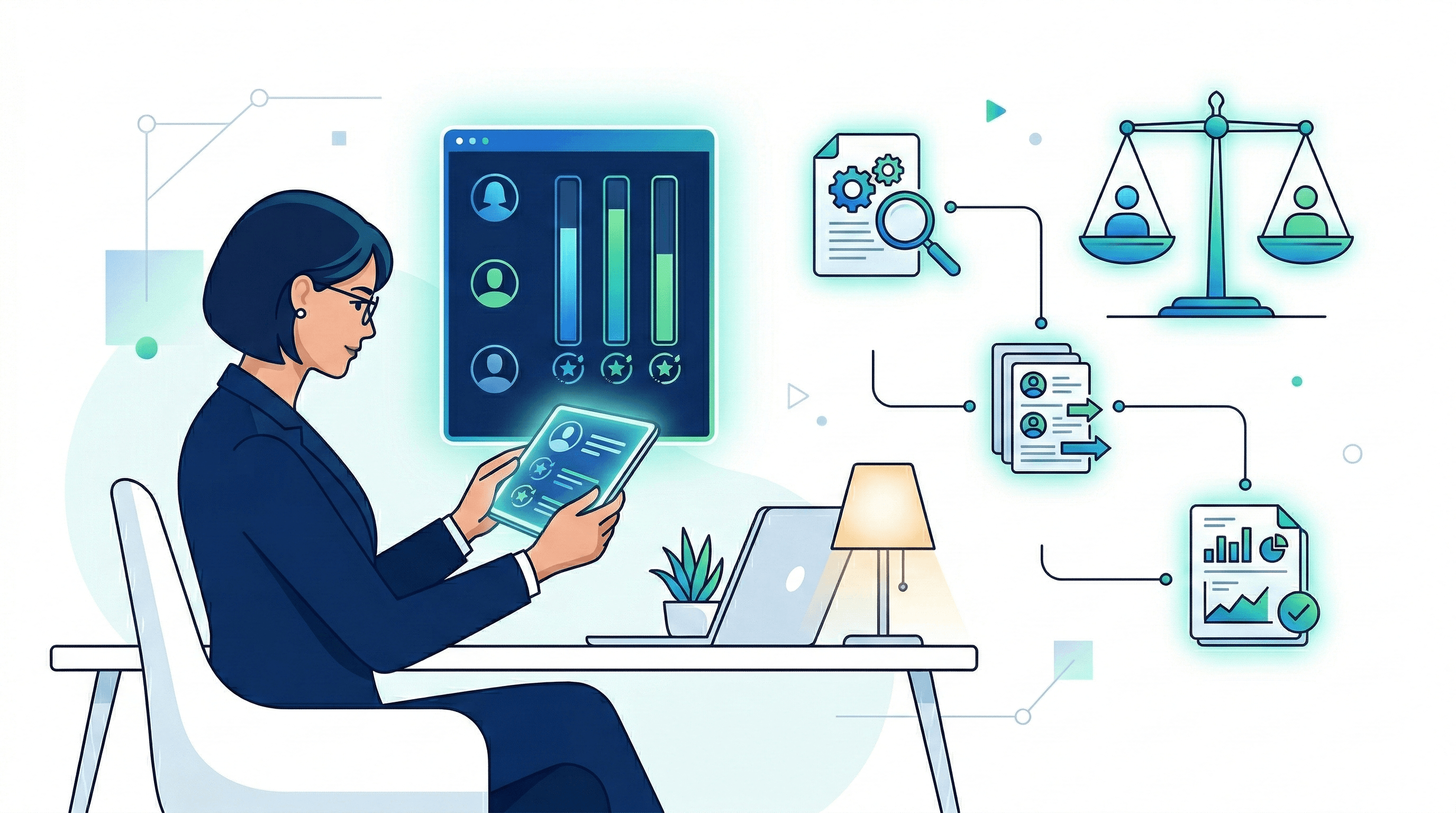
Illustration by Gemini Nano Banana
Skills-based hiring is the practice of evaluating candidates on demonstrable abilities and work samples instead of relying primarily on resumes, job titles, or university pedigree. Tired of resumes lying 40% of the time? Skills-based hiring uncovers real talent—and adopting it now unlocks an AI-driven hiring process that is fairer, faster, and far more predictive.
As we approach the end of the decade, the integration of AI in the hiring process has shifted from pilots to core workflows. 85% of employers use skills-based hiring tools, boosting hire quality by 70% and retention by 91% (Scion Staffing). The benefits of AI in hiring process optimization are incredibly clear. This guide is practical and recruiter-friendly: you'll get a straight-forward framework, a copyable rubric, short case studies, and a checklist to use an AI hiring process today.
Why move to skills-based hiring?
Resume-first hiring is noisy and biased. Studies show resumes lie 40% of the time (Forbes), and traditional resume screening wastes roughly 23 hours per hire while missing hidden gems. Alternatively, using AI for hiring process enhancements upgrades structured interviews and work-sample tests to be among the most predictive selection methods available.
The ROI over degree-based hiring
Skills-based approaches predict job performance 5x better than degrees, widen talent pools up to 19x, and save $1,200-$2,300 per role via faster hiring and lower turnover. Degree-based methods slow processes, raise costs from mismatches, and limit diversity.
| Metric | Skills-Based Hiring | Degree-Based Hiring |
|---|---|---|
| Talent Pool | 6-19x larger | Narrow, excludes non-degreed |
| Time-to-Hire | 3 weeks faster | Slower cycles, prolonged vacancies |
| Cost per Hire | Lower (less turnover/training) | Higher ($1,200+ extra/role) |
| Performance Predict | 5x stronger link | Mixed; degree ≠ skills |
| Retention | 34% higher | Lower for credential mismatches |
Why Skills Win in 2026: 95% of firms report skills hires outperform degree-required ones, with identical productivity but better retention—ideal for tech and dynamic roles. 70% of firms use it for entry-level roles (Scion Staffing). To keep up, AI recruitment solutions for improving hiring process efficiency are becoming standard.
How AI enables objective candidate scoring
In 2026, 43% of HR tasks are now AI-integrated—up from 26% in 2024. Adoption is accelerating amid subdued labor markets. 76% of HR leaders view AI as critical for talent acquisition, with AI tools speed up hiring process timelines by up to 75% and improving quality hires by 9%. Using AI assessment tools hiring process 2025 benchmarks proved this acceleration is here to stay.
What AI does with data
- Extracts evidence & verifies claims: AI in hiring process objectively verifies candidate claims via code tests or transcripts, helping in areas where 53% of recruiters struggle (Forbes).
- Scores against anchors: converts qualitative answers into numeric scores (0–100) using a rubric.
- Normalizes across candidates: adjusts for task difficulty or cohort effects.
- Summarizes strengths/weaknesses and creates a shareable report.
Practical framework — step-by-step to score candidates objectively
1. Define the skills & rubric for skills-based hiring
Start with the job outcome and target 3-5 must-haves (e.g., problem-solving). Score 1-5 (or 0-100) by assessment type (scenario, voice/text, code task).
{
  "role": "Front-end Engineer (Junior)",
  "skills": [
    {"label":"JavaScript","weight":0.30,"buckets":[0,50,70,85,100]},
    {"label":"Component Design","weight":0.25,"buckets":[0,50,70,85,100]},
    {"label":"Problem Solving","weight":0.20,"buckets":[0,50,70,85,100]},
    {"label":"Communication","weight":0.15,"buckets":[0,50,70,85,100]},
    {"label":"Test Discipline","weight":0.10,"buckets":[0,50,70,85,100]}
  ]
}
2. Automate screening
- Use async voice/text/code questions via interview automation. Auto-transcripts eliminate scheduling. Incorporating consistent AI hiring practices streamlines candidate communication.
- Keep tasks short: 20–45 minutes max for work samples; 2–4 minute video responses for behavioral questions.
- Include clear instructions and success criteria so AI grading is consistent. Modern AI hiring tools rely on strict rubric definitions.
3. Score & Decide Bias-Free
- AI aggregates into skill scores, flags strengths/weaknesses. With AI hiring software, these scores become accessible and standardized.
- Human audit cuts bias; human oversight builds trust (only 26% of candidates fully trust AI alone, so hybrid agentic models are key (TalentMSH)).
- While AI bias in hiring process is a valid concern, audit periodically for disparate impact. Ethical tools with audits prevail in combatting AI in hiring process bias.
Metrics & outcomes to track
- Talent pool size: monitor expansion, up to 19x larger by stripping degree requirements.
- Time-to-hire: usually 3 weeks faster.
- Quality of hire & retention: performance ratings at 3 and 6 months correlated with initial scores.
- Pass/fail precision: percent of AI "pass" candidates who become successful hires vs false positives.
The AI-driven recruitment platforms impact on hiring processes is easy to measure when actively tracking these baseline statistics.
Example workflow using an AI screening tool
The Real Win (Micro-case): A founder pastes their job description into an AI tool. They receive scored reports in hours, cut time-to-hire by 50%, and hire overlooked talent from a talent pool that's 15.9x bigger.
Your biggest hiring blind spot? Ready for skills-based hiring that works? ZScreen automates first-rounds: voice/text/code questions, skill scores, strengths/weaknesses, and transcripts—delivering shareable PDFs straight to your inbox.
Conclusion
Skills-based hiring combined with AI candidate screening and interview automation turns subjective hiring into a repeatable, auditable process. Start small (1 role), iterate your rubric, and measure outcomes. Over time you'll reduce time-to-hire, improve quality-of-hire, and build fairer hiring processes, while reaping 40% productivity gains (Hiring Lab).
ZScreen is an AI-powered SaaS tool that helps founders and recruiters automate first-round interviews and delivers scored reports straight to the inbox. It supports voice/text/code questions, generates skill scores, strengths/weaknesses, transcripts, and shareable PDF reports — so you can move from CVs to evidence quickly. Learn more at zscreen.co.
Ready to automate first-round interviews and get objective candidate scoring? Try ZScreen or request a demo at zscreen.co.
Share this guides
Ready to upgrade your screening?
Join thousands of modern hiring teams using ZScreen to hire faster and fairer.